
The fleet owner’s guide to electric trucks and vans
March 20, 2024Businesses that require their fleet vehicles to haul equipment and products now have a variety of EV options.
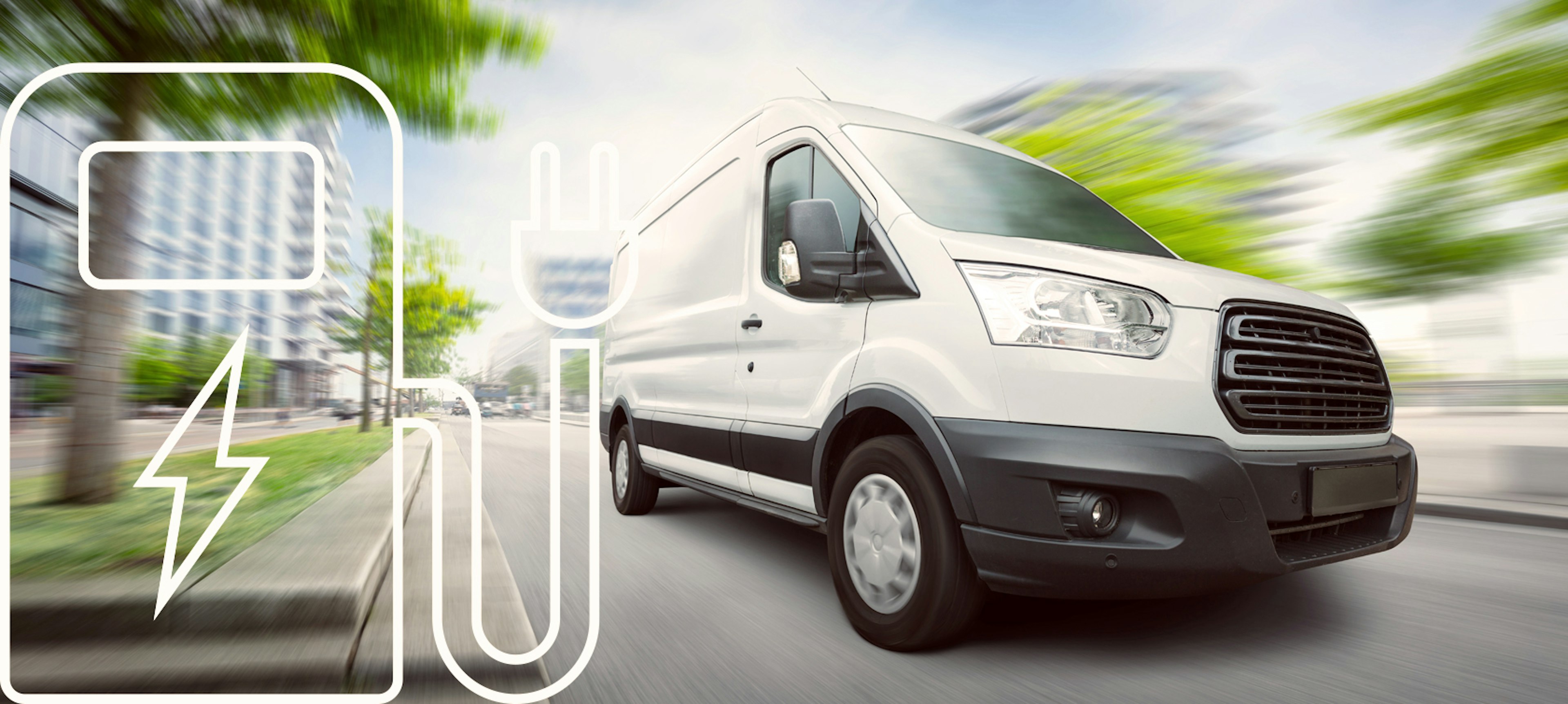
While the EV truck and van market has experienced some turbulence—with several high-profile models discontinued in late 2025—the vehicles that remain in production are more capable, more refined, and better supported than ever.
That said, the market has shifted. Federal EV tax credits expired on September 30, 2025, and several OEMs — including Ford (F-150 Lightning), GM (BrightDrop), and Stellantis (Ram 1500 REV BEV) — have discontinued or cancelled fully electric truck and van models, citing slower-than-expected demand and changing regulatory environments. The vehicles listed below are some of the electric trucks and vans that are currently in production and available for fleet acquisition in 2026.
Electric cargo vans
Electric cargo vans remain one of the strongest use cases for fleet electrification. With most light-duty commercial vehicles averaging roughly 80 miles per day, even modest EV range covers the majority of fleet operations with charge to spare. Electric vans offer fuel savings of 60–70% compared to gasoline equivalents, up to 40% savings in maintenance costs, and the ability to power tools and equipment directly from the vehicle—eliminating the need to haul heavy generators.
Electric cargo vans are typically used for two purposes: last-mile delivery and mobile work operations. Last-mile delivery vans offer excellent maneuverability for urban and suburban routes. Electric work vans give drivers the ability to plug light-duty tools directly into their van, making them ideal for trades like HVAC, plumbing, and electrical services.
Here are some of the electric cargo vans currently in production or soone available for fleet purchase:
Ford E-Transit
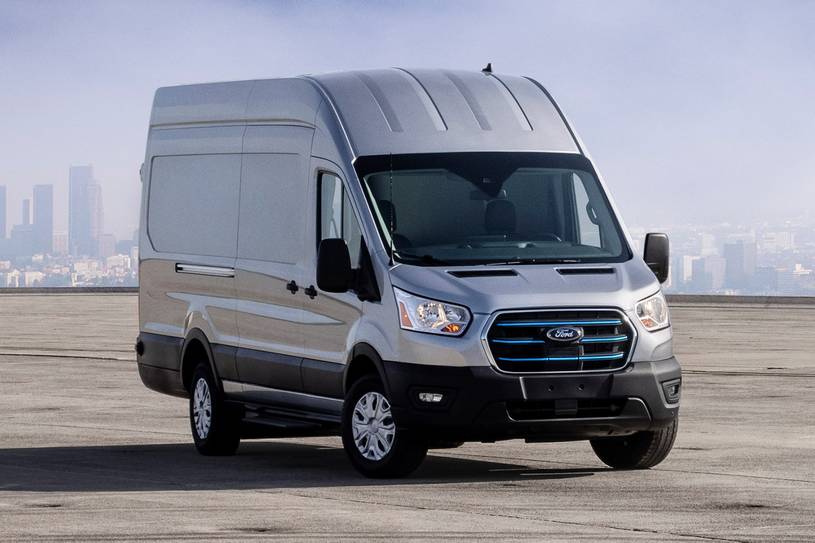
Range: Up to 159 miles Payload: Up to 4,201 pounds (varies by configuration) Cargo Volume: Up to 536.4 cubic feet GVWR: Up to 9,500 lbs Cost: Starting around $49,000–$60,000 (varies by configuration) Status: In production
Highlights: The Ford E-Transit remains the most affordable and most widely available electric cargo van on the market. For the 2026 model year, Ford has added Chassis Cab and Cutaway versions with a 156-inch wheelbase option, introduced a dual onboard charger, and made a vapor injection heat pump standard—improving cold-weather range performance. The E-Transit is available in eight body configurations across three roof heights and two lengths, and its compatibility with existing Transit upfit equipment (shelving, racks, partitions) means fleet owners can transition without replacing their upfit investments. Ford Pro’s connected fleet management platform provides real-time telematics, charging management, and over-the-air software updates.
**What to watch out for: **At 159 miles of range, the E-Transit is best suited for fleets with predictable, shorter daily routes—which describes the majority of commercial van operations. If your routes regularly exceed 120 miles per day, or you operate in extreme cold without access to depot charging, consider the eSprinter or plan for mid-day charging. The E-Transit supports DC fast charging that adds approximately 45 miles of range in 15 minutes.
RAM ProMaster EV
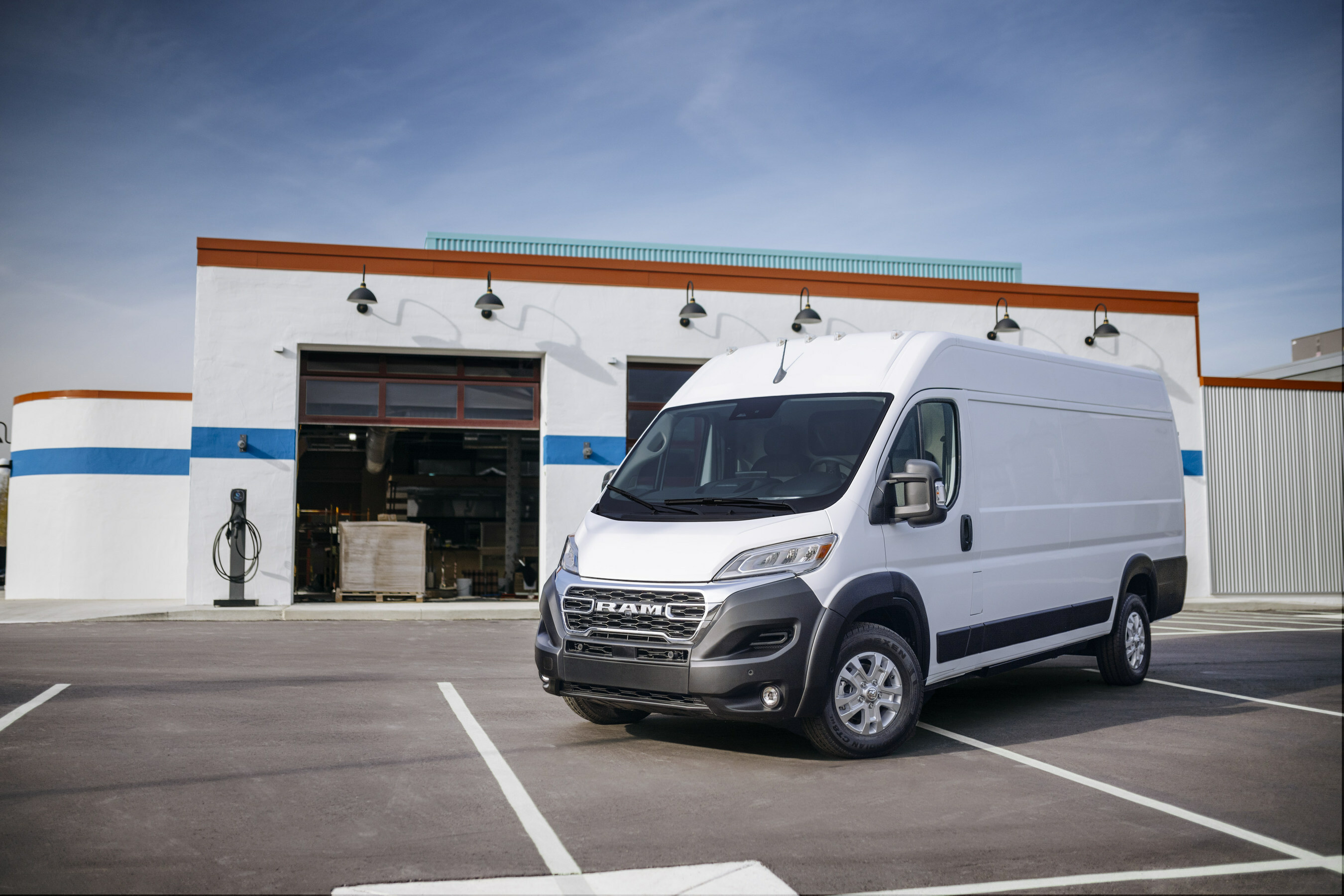
Range: Up to 162 miles (city driving) Payload: 2,030 lbs (delivery) to 3,020 lbs (cargo) Cargo Volume: Up to 524 cubic feet (cargo variant) Cost: Starting around $69,000 (delivery) to $86,995 (cargo) Status: In production now
Highlights: The ProMaster EV includes One Pedal Driving Mode for regenerative braking efficiency, automated emergency braking, rear cross-traffic alert, and adaptive cruise control. In real-world fleet testing, the ProMaster EV has been praised for its rapid DC fast charging speeds—one of the fastest in the segment—and its smart packaging designed specifically for last-mile delivery operations. The cargo van configuration is now available alongside the delivery van, offering fleet managers flexibility across use cases.
What to watch out for: The ProMaster EV is currently available as a 3500 high-roof model with a 159-inch wheelbase. Future variants are expected to include different roof heights, passenger van, and cab chassis configurations. Ram has also confirmed the return of the ProMaster City compact van on the global Pro One platform, with an EV option expected in the coming years.
Mercedes Benz eSprinter
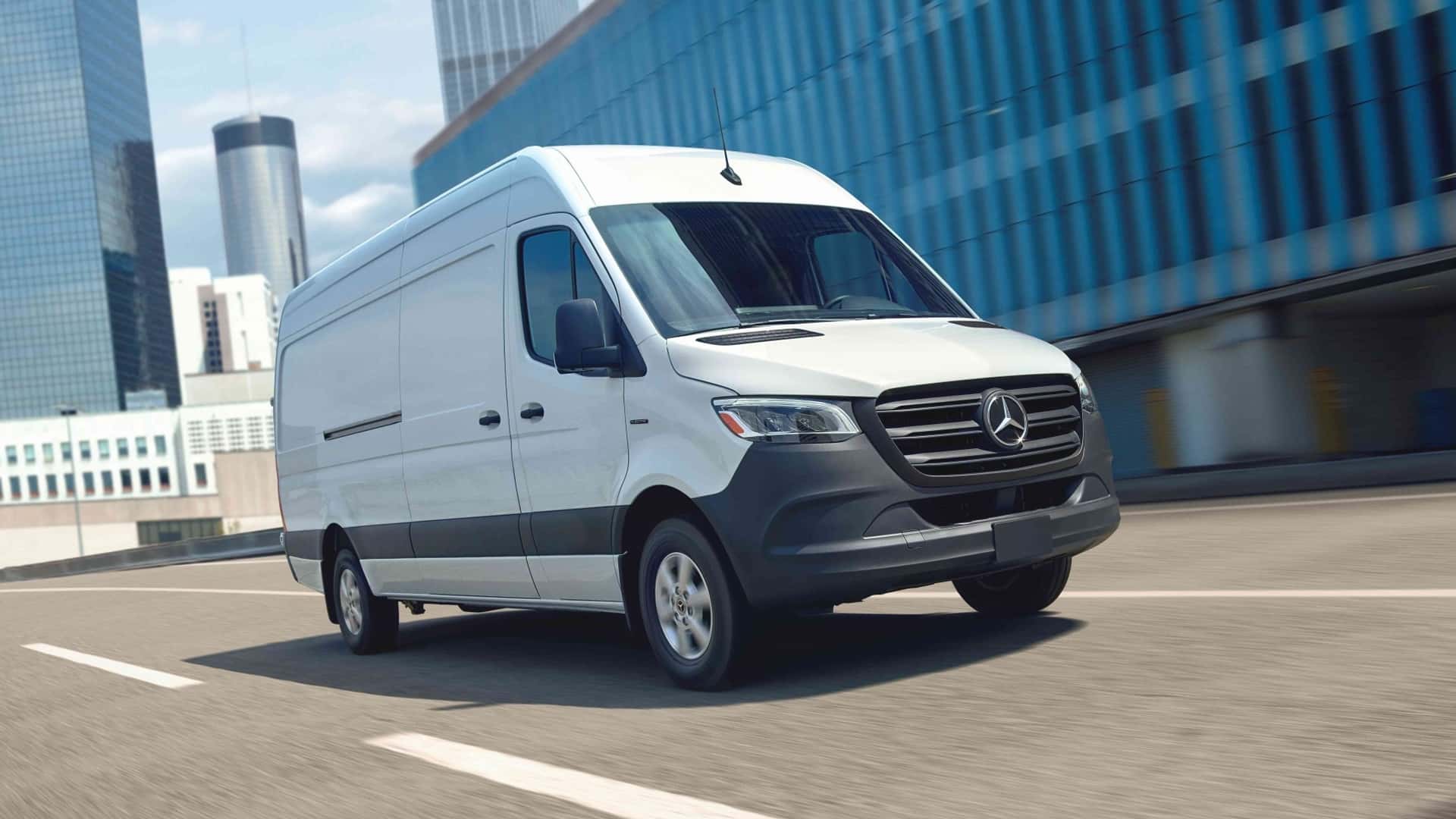
Range: Up to 249 miles (EPA estimated) Payload: Up to 2,624 pounds Cargo Volume: 488 cubic feet Towing Capacity: 4,277 lbs **Cost: **Starting around $74,000–$78,000 Status: In production now
Highlights: The eSprinter offers the longest range in the electric cargo van segment at up to 249 miles, thanks to its 113 kWh lithium iron phosphate (LFP) battery—a newer chemistry that eliminates cobalt and nickel, improving sustainability and longevity. The eSprinter’s MBUX infotainment system includes active thermal management that preconditions the battery for optimal charging when a station is set in the navigation. Among the electric vans tested in 2025, the eSprinter was consistently rated the most refined in terms of ride quality, cabin noise, and driver comfort—making it well-suited for premium delivery services or executive shuttle operations.
**What to watch out for: **Currently available only as a high-roof cargo van with a 170-inch wheelbase. Max payload of 2,624 lbs is approximately 30–45% less than an ICE Sprinter, a compromise common to all electric commercial vans due to battery weight. For fleets needing extra power, opt for the high-horsepower variant. The top speed is limited to 75 MPH. Mercedes has announced next-generation electric vans on the dedicated VAN.EA platform, expected to begin rolling out in 2026–2027.
Rivian Electric Delivery Van (EDV 500 / EDV 700)
Range: Up to 161 miles (EDV 500) / 160 miles (EDV 700) Cargo Volume: Approx. 500 cu ft (EDV 500) / 700 cu ft (EDV 700) Cost: Must request fleet pricing Status: In production; expanding beyond Amazon
Highlights: Rivian’s electric delivery vans are purpose-built EVs (not electrified versions of ICE platforms) designed from the ground up for commercial delivery operations. Originally developed in partnership with Amazon, the EDV fleet has grown rapidly and now represents the largest electric last-mile delivery fleet in the U.S. Rivian CEO Robert Scaringe confirmed in February 2026 that AWD variants and larger battery pack options are in development, which would expand the EDV’s applicability beyond urban delivery to routes with varied terrain and weather conditions. Rivian is also making the EDV available to fleet customers beyond Amazon.
**What to watch out for: **The current EDV models use a front-wheel-drive layout. Range is adequate for most urban delivery routes but may require depot charging for higher-mileage operations. Fleet pricing is not publicly listed. Availability may still be constrained depending on your region and fleet size.
Electric pickup trucks
The electric pickup truck landscape shifted dramatically in late 2025. Ford discontinued the F-150 Lightning in December 2025 after failing to manufacture the truck profitably, and Stellantis cancelled the fully electric Ram 1500 REV in September 2025, citing slowing demand for battery-electric pickups. Both companies are pivoting toward range-extended electric vehicles (REEVs) that pair electric motors with gas generators. Despite these setbacks, there are still viable all-electric pickup options for fleet managers. Here are some of the top electric pickup trucks to consider for your fleet:
Chevrolet Silverado EV WT
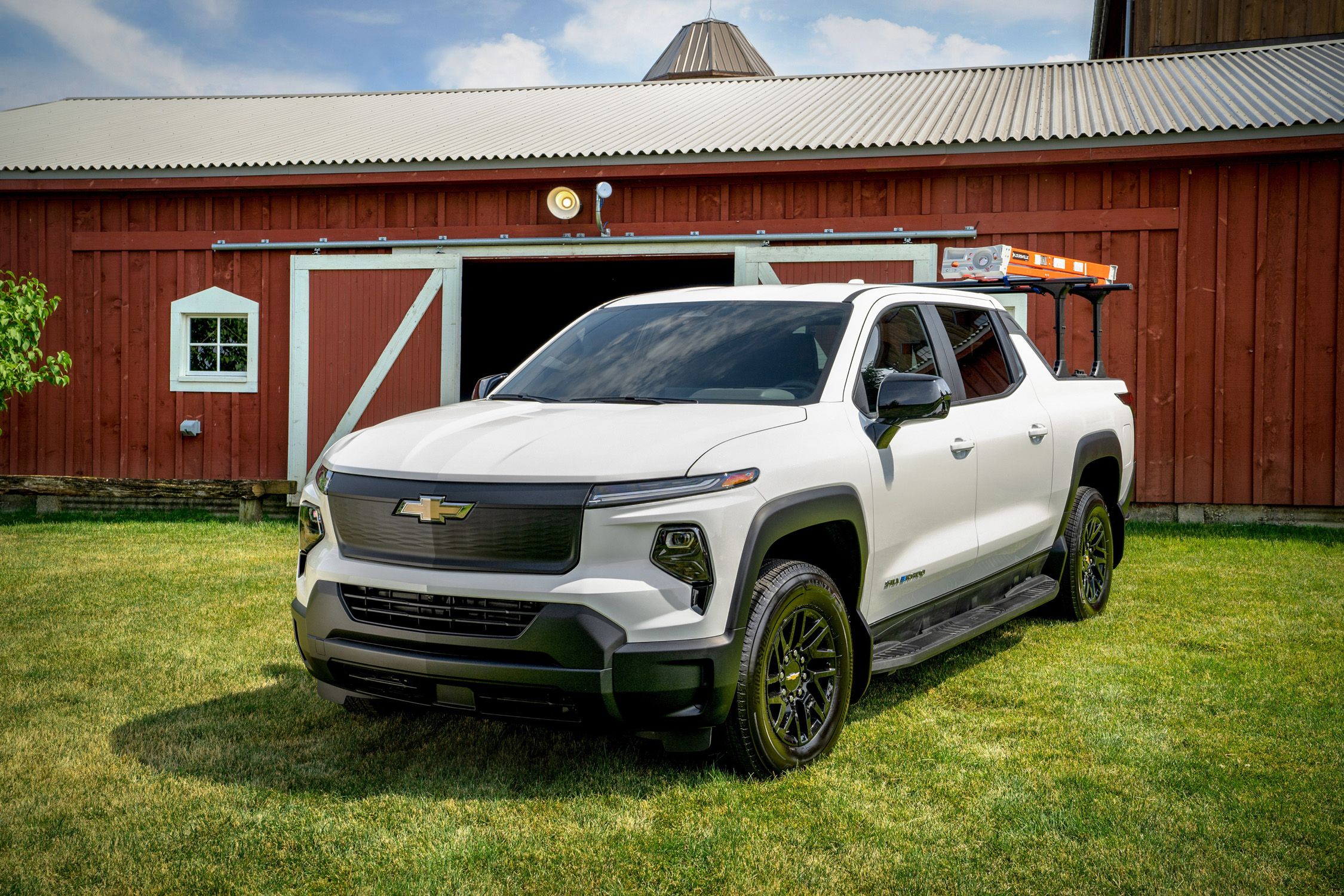
Range: 283 to 493 miles (depending on battery/trim) Payload: Up to 1,800+ lbs in the bed, plus eTrunk storage Towing: Up to 12,500 lbs Horsepower: 510 hp (standard) to 725 hp (Max Range) Cost: Starting at $52,800 (Work Truck) to $89,200 (LT Max Range) Status: In production now; Work Truck trims available for fleet customers
Highlights: The Silverado EV is an excellent all-electric pickup option for fleet managers in 2026. The Work Truck trim starts at $52,800 and is designed specifically for commercial use, with dual-motor AWD delivering 510 horsepower and up to 12,500 lbs of towing capacity. The Max Range battery pack offers up to 493 miles of EPA-estimated range—the longest of any electric pickup on the market. The Multi-Flex Midgate allows the wall between the bed and backseat to fold down, creating extended cargo capacity for longer items. Up to 11 outlets and 10.2 kW of offboard power make the Silverado EV a genuine mobile worksite. Four-wheel steering (CrabWalk) provides a tighter turning radius, and the new Trail Boss trim adds serious off-road capability. DC fast charging adds 74–120 miles of range in just 10 minutes with 350 kW charging.
What to watch out for: The Silverado EV is available only as a crew cab with a 5’11” bed. Work Truck trims are fleet-only; retail buyers choose from the LT and Trail Boss trims. The standard-range battery (283 miles) is the most affordable but may not suit high-mileage operations. Consider the Extended Range or Max Range packs for fleets with longer daily routes or towing demands.
Tesla Cybertruck
Range: Up to 325 miles (AWD) Payload: Up to 2,500 lbs Towing: Up to 11,000 lbs Horsepower: 600 hp (AWD) / 845 hp (Cyberbeast) Cost: Starting around $79,990 (AWD); $114,990 (Cyberbeast) Status: In production now
Highlights: The Cybertruck is engineered as an EV from the ground up—not an electrified version of an existing platform. Its stainless steel exoskeleton is highly durable, and the 6-foot vault bed with powered tonneau cover provides 67 cubic feet of cargo space. The Cybertruck supports peak DC fast charging at up to 500 kW at Tesla’s latest V4 Superchargers, and its native NACS charging port provides seamless access to the nation’s largest fast-charging network. Standard features include adaptive air suspension, four-wheel steering, and steer-by-wire. The front trunk (frunk) provides additional enclosed storage. Multiple 120V and 240V outlets make the Cybertruck functional as a mobile power source on job sites.
What to watch out for: The Cybertruck’s polarizing design may not suit every fleet’s brand image. Its unconventional styling also means that standard truck accessories and upfit solutions designed for conventional pickups will not be compatible. Build quality concerns and a high price point relative to the Silverado EV Work Truck limit its appeal for cost-sensitive fleet applications. Currently available only as a crew cab; no cab chassis or work-specific configurations are offered. The previously available rear-wheel-drive model has been discontinued.
Rivian R1T
Range: Up to 420 miles (Max battery) Payload: Up to 1,760 lbs Towing: Up to 11,000 lbs Horsepower: 533 hp (Dual Standard) up to 1,025 hp (Quad) Cost: Starting at $72,285 (Dual Standard) Status: In production now
**Highlights: **The Rivian R1T is one of the most capable and refined electric pickups available. It features a unique Gear Tunnel pass-through between the cab and bed that provides additional enclosed, lockable storage—ideal for tools, equipment, or valuables. The front trunk is substantially larger than the Cybertruck’s. Adaptive air suspension offers up to 14.9 inches of ground clearance, and the R1T has earned strong reviews for its off-road capability and ride comfort. Rivian is rolling out its Universal Hands-Free driver assistance system. Multiple battery options (Standard, Large, Max) let fleet managers match range to their operational needs without overpaying for capacity they don’t need.
**What to watch out for: **The R1T is a midsize pickup, slightly smaller than a full-size Silverado EV or Cybertruck. Payload capacity of 1,760 lbs is lower than competitors. Rivian’s service network is still growing; ensure there’s adequate service coverage in your operating area before committing to a fleet purchase. The R1T is better suited for light-duty fleet applications—field service, supervisory vehicles, sales—than for heavy hauling or construction.
Are electric vans and trucks worth the investment?
The economics of fleet electrification have become significantly clearer since these vehicles first hit the market. Electricity costs roughly $0.04–$0.05 per mile versus $0.12–$0.17 per mile for gasoline, and maintenance costs are typically 30–50% lower thanks to fewer moving parts, no oil changes, and reduced brake wear from regenerative braking. A 2025 Vincentric analysis found that 24 of 54 EV models already had lower five-year ownership costs than their ICE counterparts—most without the now-expired federal tax credit factored in.
That said, the upfront price premium remains real. The key is to evaluate total cost of ownership (TCO) over the vehicle’s lifecycle, not just the sticker price. For many fleet applications—especially last-mile delivery, urban service routes, and predictable daily mileage patterns—the TCO math already favors EVs. For high-mileage, long-haul, or heavy-towing operations, the calculus is more nuanced and may favor hybrids or range-extended options in the near term.
Fleet managers should also factor in depot charging infrastructure costs, available state and utility incentives (the federal 30C charger tax credit remains available through June 2026), and the operational advantages of smart charging software that can reduce electricity costs by up to 40%.
What's next?
The electric truck and van market is in a period of recalibration. Several OEMs are pivoting from fully electric to range-extended electric vehicles (REEVs) that pair electric motors with gas generators—offering electric driving for daily routes and gasoline backup for longer trips. Ford’s next-generation Lightning will be a REEV, and the Ram 1500 REV (formerly the Ramcharger) will use the same approach. These vehicles may offer a compelling middle ground for fleets that need electric capability without range anxiety.
On the van side, GM and Hyundai announced a joint electric van program in August 2025, with U.S. production targeted for 2028. Mercedes-Benz is developing next-generation electric commercial vans on its dedicated VAN.EA platform. And Ford has indicated that an affordable commercial van with gas and hybrid powertrains is coming to replace its cancelled all-electric van project.
For fleet managers, the takeaway is clear: the vehicles available today—the Ford E-Transit, Ram ProMaster EV, Mercedes eSprinter, Chevrolet Silverado EV, and Rivian’s delivery vans and R1T—are proven, in-production options that can deliver real cost savings on the right routes. The fleets that approach electrification strategically, matching vehicles to duty cycles and building charging infrastructure in phases, will be best positioned regardless of how the market evolves.
At Mike Albert Fleet Solutions, we take pride in monitoring these developments for you. Our team of electric vehicle experts, combined with our commitment to being upfit-focused, means we take great strides to create the perfect vehicles for our clients. If you’re interested in EV technology, we can find the right vehicle fit and the optimum upfit solution for you. Contact us for a free fleet consultation today.
Skills covered in the class
Fleet Electrification
Vehicle Specification
Driver Retention
Operational Efficiency
Did you enjoy this class?
Share it with your organization and colleagues.
Similar Classes

Electric, Hybrid & Alt. Fuel
Powering EVs: The in's and out's of fleet charging infrastructure
March 3, 2022

Electric, Hybrid & Alt. Fuel
The advanced guide to fleet electrification
February 12, 2024

Vehicle Maintenance & Services
How to decide which fleet management services are right for you.
February 13, 2022